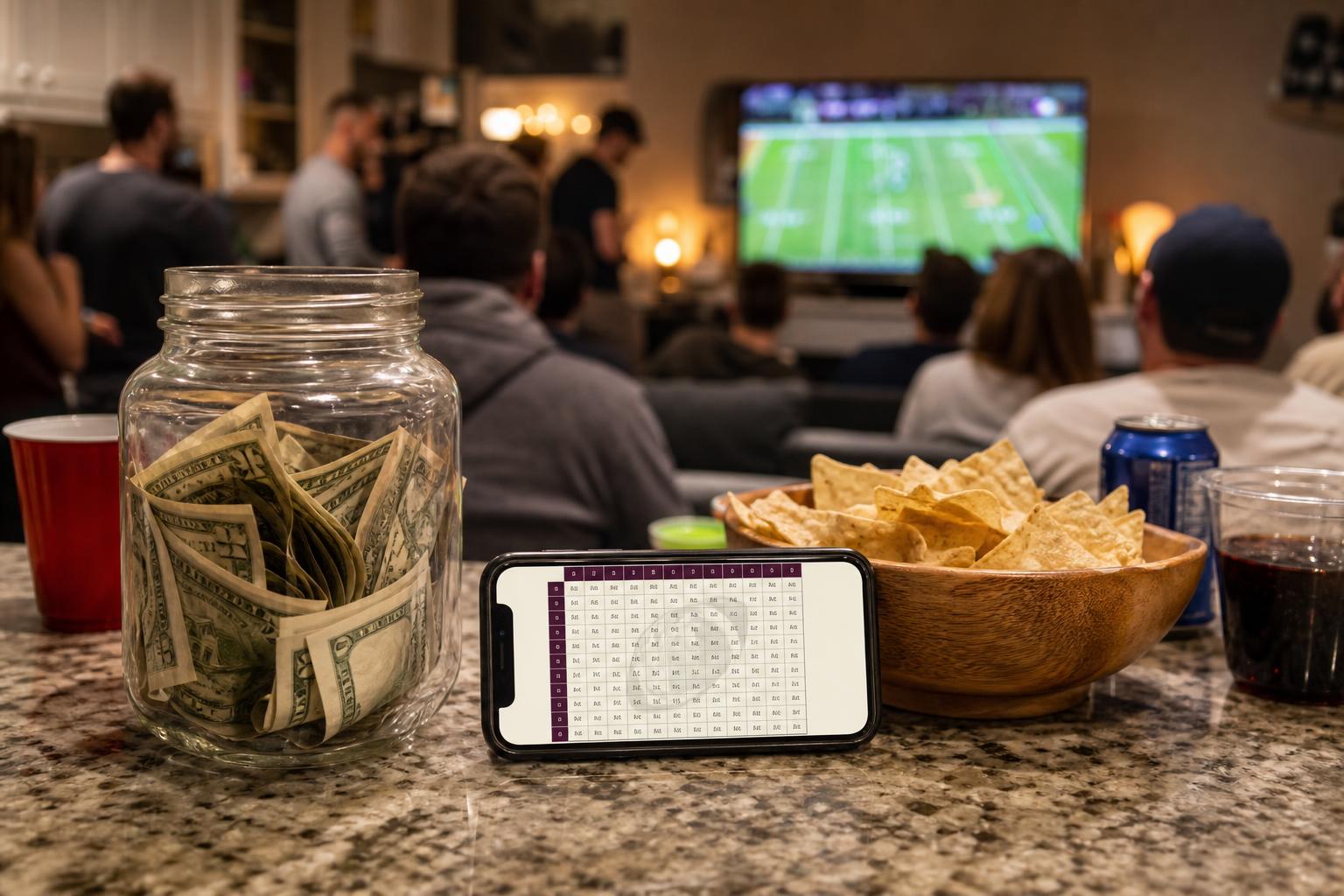
A 50/50 raffle board is the fastest payout structure to explain, and that's exactly why booster clubs keep reaching for it. Sell 100 squares, half the money goes to one lucky number, the other half stays with the team. One sentence and everybody gets it. But the thing that makes a 50/50 easy to pitch is also the thing that quietly slows down your sales, and I want to walk through why before you lock in your structure.
First, the honest logistics note. PickMySquare runs the board, the number draw, and the winner tracking, but we never touch a dollar of it. No entry fees, no prizes, no payouts move through the site. Whatever pot you build and however you split it, that's cash your organizer collects and hands out in person or through Venmo, the same way a paper board on the concession stand wall always worked. Everything below is a structure you run offline, using our board to keep it honest.
How a 50/50 raffle board actually pays out
Say you set up a 10x10 grid. That's 100 squares. You price each square at $5, so a full board collects $500. In a classic 50/50, the winning square takes $250 and your cause keeps $250. Clean.
The catch is the single winner. Out of 100 people who bought in, exactly one walks away happy and 99 get nothing. That's a 1% hit rate, and people feel it. When a parent is deciding whether to grab a square at pickup, "one person out of a hundred wins" is a harder yes than it sounds. The pot looks big, sure, but one square out of a hundred feels like a long shot, because it is.
You can soften that a little by drawing per quarter instead of once at the final. Split the $250 winner pool into four $62.50 payouts tied to the score at the end of each quarter. Now four squares win over the course of the game, and four buyers have a reason to keep watching. Same total payout, same 50% to the cause, but the money reaches more hands.
Why a tiered draw usually fills the board faster
Here's my actual position: a tiered 1st/2nd/3rd structure sells better than a flat 50/50, and it isn't close.
Take the same $500 board. Instead of one $250 winner, you pay out three places from a $250 prize pool: $150 for first, $65 for second, $35 for third. Your cause still keeps its $250. Nothing changed on the fundraising side. What changed is the pitch. Now you can tell a buyer "there are three ways to win on this board," and three winners out of a hundred just feels more winnable than one, even though the math on any single square barely moved.
People don't buy raffle squares on expected value. They buy on the story they tell themselves while handing you five bucks. "I could win something" fills a board. "There's a 1% chance I win everything" leaves you chasing the last 20 squares two days before kickoff. If you've ever run a board that stalls at 78 sold, tiered payouts are the cheapest fix you've got, because they cost the organizer nothing.
A common tiered setup for a football board ties the tiers to game moments: halftime score pays third, third-quarter score pays second, final score pays first. That builds a little arc into the game. Nobody's out of it until the final gun, which is the whole point.
Prize-in-kind boards: skip the cash entirely
If you'd rather not deal with cash prizes at all (or your organization's rules make cash raffles a headache), fill the winner slots with stuff instead of money.
A gift-basket board is my favorite version of this. Every square is still $5, and the whole $500 goes to your cause, but the prizes are donated: a $50 team-gear basket for first, a $25 local-restaurant gift card for second, a swag bag for third. Because the prizes were donated, 100% of what you collect is fundraising. Parents love it, local businesses love the shout-out, and you never have to count out bills at the concession stand.
This works especially well for school and youth-sports boards where "cash prize" raises eyebrows but "gift card from the pizza place on Main Street" raises zero. You get all the engagement of a tiered draw without a single dollar leaving the pot. If a fundraiser is your real goal, this is often the strongest option, and it pairs naturally with the ideas in our football squares fundraiser ideas guide.
Multi-winner boards are a setting, not a spreadsheet
Here's the part that trips people up on paper boards and doesn't have to. When you run more than one winner, per-quarter payouts or a first/second/third draw, you're tracking multiple winning squares against multiple score checkpoints. On a paper grid that means a lot of circling and second-guessing, and every year somebody argues about which square actually won the third quarter.
On a PickMySquare raffle board, multi-winner is just a setting. You tell the board how many winners you want and which game moments they're tied to, and it marks the winning squares for you as the scores come in. No arguing at the whiteboard, no "wait, whose number was 7-3 at halftime." The board keeps the receipt.
That's really the only piece we automate here. The pot stays with you, split however you decided. We just make sure everyone can see the same board and agree on who won, which is the part that actually causes fights. If squares are new to you or the people you're recruiting, point them at our beginner's guide to football squares first so nobody's confused about how numbers get assigned.
Picking your structure before you sell a single square
Decide the payout before you print a flyer or share a link, because changing it midway makes you look disorganized and gives buyers a reason to ask for their money back. Quick gut-check:
Running a big-pot event for adults who want a real prize? A 50/50, ideally paid per quarter, is fine and easy to sell. Trying to fill a board fast with a wide, casual crowd? Go tiered. Fundraising for a school or youth team where cash gets side-eye? Prize-in-kind wins.
Whatever you pick, price the squares so a full board hits a number that feels worth it. $5 squares on a 100-square board is the reliable middle. $2 lowers the barrier for kids' teams, $10 or $20 works for an adult crowd that wants a fat pot. Just remember every price is your collection to manage, not something the site processes.
50/50 Raffle Board FAQ
What is a 50/50 raffle board?
It's a squares board where the pot is split down the middle: half goes to one or more winning squares, half stays with the organizer or cause. You set the price per square, and a full board's total decides the size of each half.
Does PickMySquare collect the entry money or pay the winners?
No. We run the board, draw the numbers, and mark the winning squares. Collecting square money and handing out prizes is something the organizer does offline, cash or Venmo, exactly like a paper board.
Is a tiered payout better than a straight 50/50?
For filling a board fast, usually yes. Three smaller prizes give more people a reason to buy in than one big prize, and the fundraising cut stays the same. A flat 50/50 is easier to explain but tends to stall near the end.
Can I have more than one winner on a board?
Yes, multi-winner is a setting. Tie payouts to each quarter or run a first/second/third draw, and the board tracks every winning square against the right score checkpoint for you.
How do prize-in-kind boards work?
Instead of cash prizes, winners get donated items: gift baskets, gift cards, team gear. Since the prizes are donated, everything you collect goes to your cause, and you never handle prize money at all.
What should I charge per square?
$5 on a 100-square board is the reliable default. Drop to $2 for kids' teams, bump to $10 or $20 for an adult crowd that wants a bigger pot. Whatever you set, you're the one collecting it and paying the winners.
Set up your raffle board in a couple minutes
Pick your payout structure, add your squares, and let the board track every winner for you. Free to run, no money moves through the site.
Create Free Board →