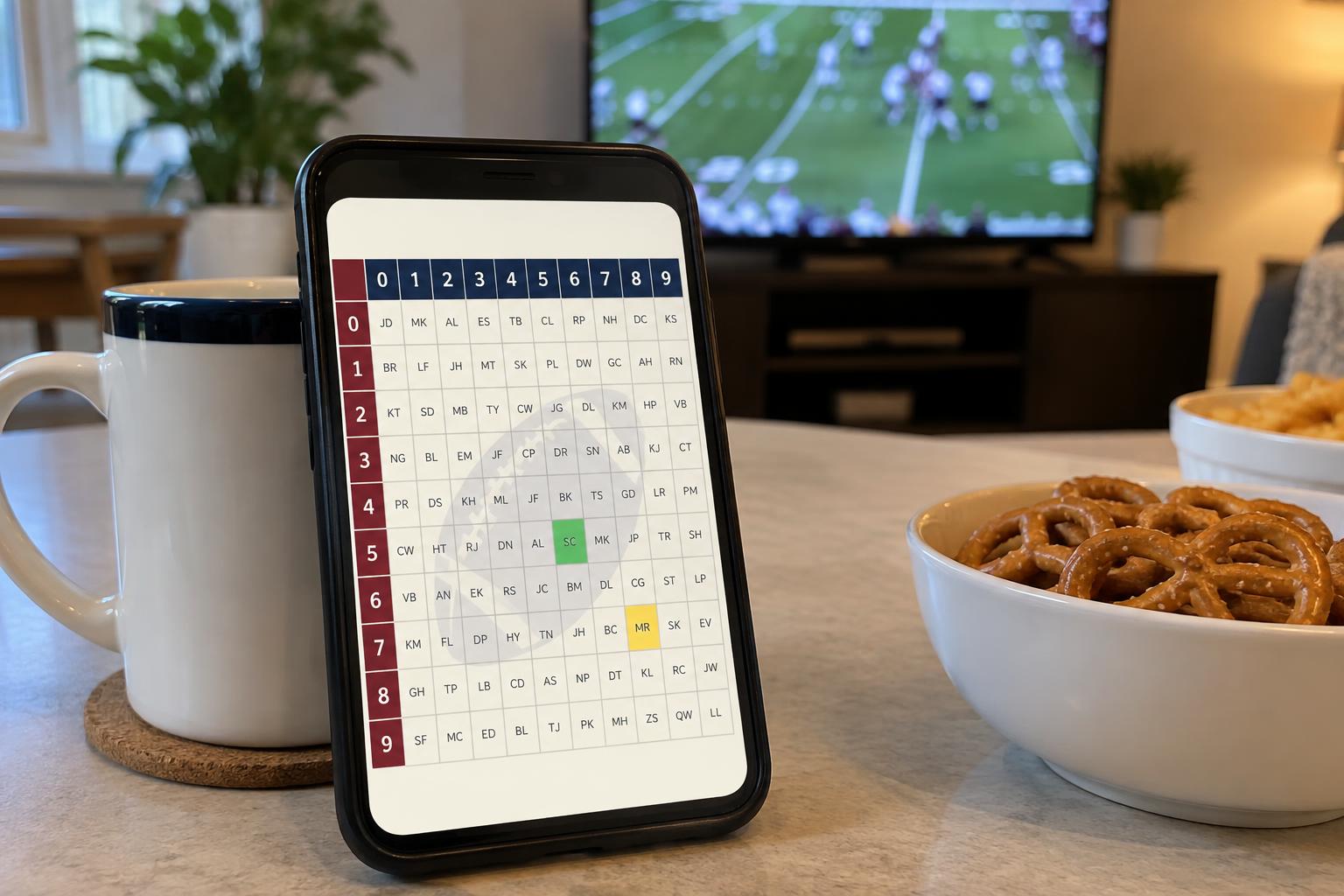
Picture a 21-14 game at the end of the first quarter. In a plain squares grid, one person wins: whoever owns the square where the away team's last digit and the home team's last digit cross. One payout, one happy player, ninety-nine people who got nothing that quarter. Reverse football squares takes that same scoreline and pays a second person too, the one sitting on the flipped version of that square. Same game, same grid, double the people with a reason to care when the quarter ends.
I like reverse squares for exactly that reason. The number one complaint I hear about a normal board is that most of the table checks out by halftime because their numbers are cold. Reverse fixes a chunk of that without changing a single thing about how you set up the board. If you already know the basics, this is a ten-second rule you bolt on top. If you don't, the beginner's guide to football squares walks through the plain version first, and the rest of this makes a lot more sense after it.
How the flip actually works
Standard squares reads one coordinate. Say the away team is down the left axis and the home team runs across the top. A 21-14 score lands on the square where left digit 1 (from 21) meets top digit 4 (from 14). That's your winner.
Reverse squares reads the same two digits in the opposite order. You swap them: now you look for left digit 4 meeting top digit 1. That second square wins too. The scoreboard didn't change. You just asked the grid a second question, "what if the digits were the other way around," and paid whoever answered it.
So every scoring checkpoint produces two winners instead of one. Quarter one pays a straight winner and a reverse winner. Same at the half, at the end of the third, and at the final. On a board that pays four times, that's eight payouts across the night instead of four.
There's one edge case worth knowing. When both teams land on the same last digit, a 17-7 game for instance (both end in 7), the straight square and the reverse square are the same square. One person just won both. That's not a bug, it's the math, and it happens often enough that you should decide up front how you want to handle it. Most hosts pay that person both shares, which is clean and fair. A few split the reverse payout back into the pot. Either is fine, just say so before the game starts.
Why bother, honestly
The whole appeal is engagement. On a normal board, if your numbers are a 3 and an 8, you're probably dead on arrival, because scores cluster around 0, 7, 3, 4, and 1. Reverse squares gives those cold-number people a second shot on every single score. An 8-3 square that would never hit on its own suddenly hits when a 3-8 scoreline shows up. More live squares means more people glued to a late field goal that "doesn't matter," which is the entire point of running a board in the first place.
It also smooths out the luck. Squares is random by design, that's the charm of it, but a reverse board spreads the winnings across more of the room over a full game. Fewer people walk away having never sniffed a payout. If you're running a board for family or a casual group where the goal is everybody has fun, that matters more than you'd think. We dug into that whole "keep the table alive" idea in the strategy guide, and reverse is probably the single easiest lever you can pull.
Splitting the money
Here's where people get tripped up. If your pool pays $100 per quarter and you add a reverse winner, that's two people getting paid per quarter, so settle where that money comes from before you start.
The two common approaches:
- Split the existing pot. Each quarter's prize gets cut in half. The straight winner takes one half, the reverse winner takes the other. Your total payout doesn't change, it just reaches more people. This is the default most hosts land on, and it's what I'd recommend for a first-timer.
- Pay both in full. The reverse winner gets the same amount as the straight winner, which means your prize pool needs to be twice as big. This only works if your square price or player count supports it. Great for a big, well-funded board. Overkill for a ten-person office game.
Splitting is cleaner because what everyone chips in stays identical to a normal board. Nobody has to pay more, the winnings just land on more squares. Whatever you pick, write it on the board before numbers get drawn. The fastest way to sour a squares game is changing a payout rule after someone's already counting their winnings.
Running it on PickMySquare
You don't have to track any of this by hand. When you create a board, reverse winners is a toggle. Flip it on and the grid highlights both the straight winner and the reverse winner at each quarter automatically, pulling live scores so you're not squinting at a TV and doing digit math during a two-minute drill. Reverse squares marks its winners with an "R" so nobody confuses the two, and the payout split you chose shows right on the board.
It works for any sport with a score, not just the NFL. Sunday games, a college rivalry, a weeknight NBA matchup, the setup is the same. If you want the full weekend-board rhythm, the NFL squares every Sunday guide pairs well with turning reverse on, because a season-long board is exactly the kind of thing where keeping everyone engaged every week pays off.
Reverse Football Squares FAQ
What's the difference between reverse squares and regular squares?
Regular squares pays the one square where each team's last digit crosses. Reverse squares also pays the square with those two digits swapped. Same scoreboard, two winners per checkpoint instead of one.
Does reverse squares cost more to play?
Not if you split the pot. What players chip in and the prize pool stay the same, the money just gets divided between the straight winner and the reverse winner. It only costs more if you choose to pay both winners the full amount.
What happens if both teams have the same last digit?
Then the straight square and the reverse square are identical, so one person wins both shares. Decide ahead of time whether they collect both or the reverse share rolls back into the pot. Either works, just make the call before kickoff.
Can I use reverse squares for college football or other sports?
Yes. Reverse squares works on any board where the winner is decided by the last digit of a score, so NFL, college, NBA, NHL, it all works the same way.
Is this the same as a bracket pool?
No. Reverse is a squares feature. Bracket pools on PickMySquare are a separate product just for NCAA March Madness. Reverse squares lives entirely on the squares side.
How do I turn reverse winners on?
It's a toggle when you set up the board. Switch it on, pick whether you're splitting the pot or paying both in full, and the board tracks the rest, flagging reverse winners with an "R" at each quarter.
Double the winners on your next board
Flip on reverse winners when you set up your grid and keep the whole room in the game right down to the final whistle. Free to create, scores update live, no app to download.
Create Free Board →