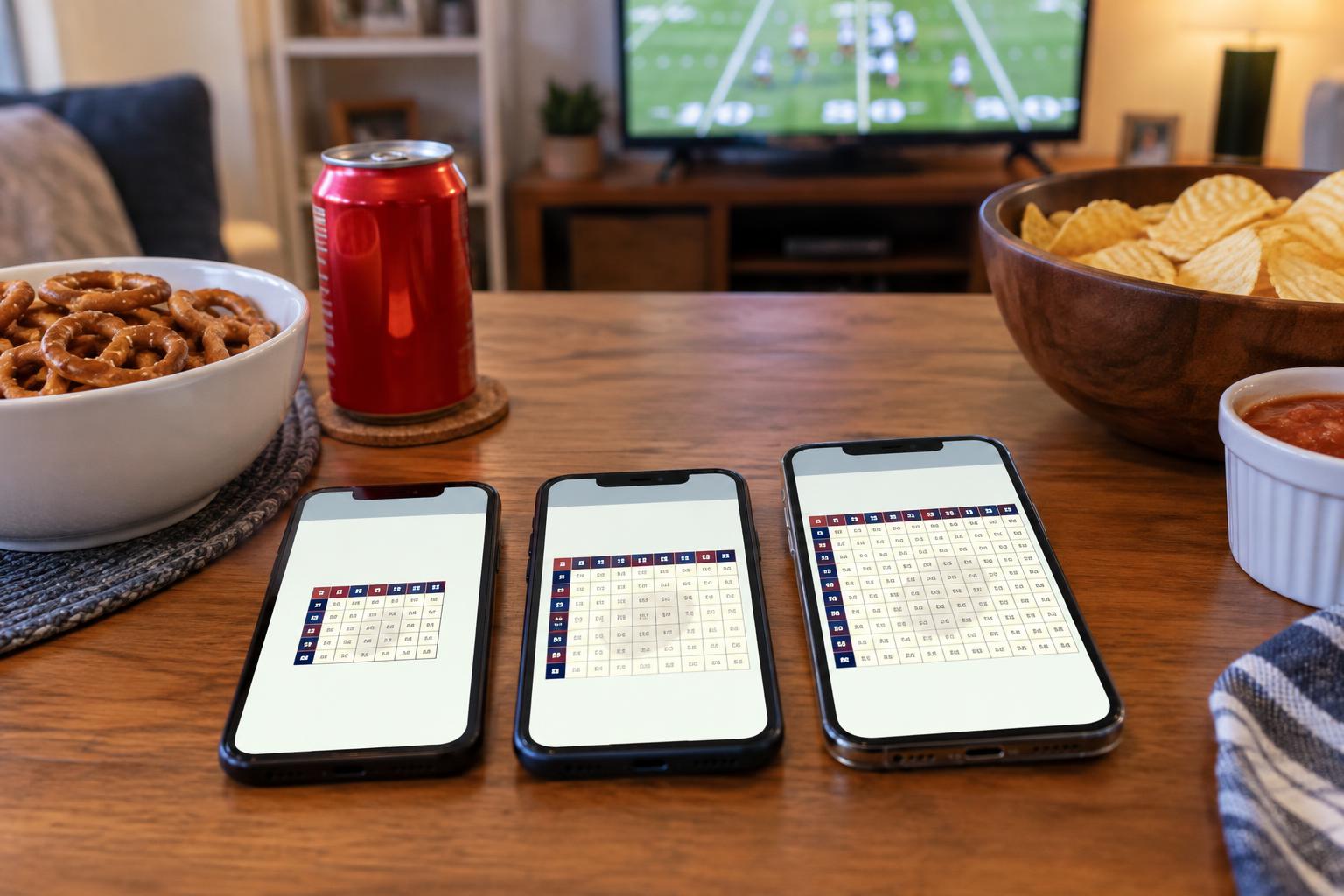
The first real decision in any squares pool isn't the teams. It's how big to make the grid. Football squares board sizes come down to three choices, and picking wrong is how a perfectly good office pool dies. I've watched one fall apart because someone printed a 100-square sheet for a group of eight, and by kickoff there were 70 empty boxes and a lot of shrugging. Board size decides whether your pool feels full and tense or half-empty and forgettable.
We're in the thick of the NFL regular season, which is exactly when weekly boards heat up. People run a fresh grid for the Sunday slate, another for Monday night, and the question every week is the same: how big should it be? So let's talk through the three sizes you'll actually use, and when each one makes sense.
The three sizes, and who they're for
A squares board is a grid. The classic is 100 squares, a 10x10 grid, with digits 0 through 9 running along the top and down the side. The score at the end of each quarter (last digit of each team's points) tells you which square wins. That's the version almost everyone pictures.
But 100 isn't a rule. It's just the most common choice. You can run a 25-square board (5x5) or a 50-square board, and both solve a very specific problem: not enough people to fill 100 boxes.
Here's the quick version before I get into the weeds:
- 100 squares (10x10): the standard. Every digit pairing from 0-0 to 9-9 exists exactly once. Cleanest odds, biggest fill requirement.
- 50 squares: a middle ground for a group of 10 to 25 people. Each person grabs a few squares without the grid looking barren.
- 25 squares (5x5): great for small groups, family game night, or a kid-friendly pool where you don't want anyone claiming 15 boxes.
Why 100 is the standard (and when it's a trap)
The 100-square board is the gold standard for a reason. When the digits 0 through 9 each appear once per axis, every possible final-digit combination is on the board. Nobody can argue about the math. A 7 and a 0 pays out just like it's supposed to, and the scoring maps directly onto how football scores actually land.
The catch is that 100 squares needs roughly 100 squares claimed to feel right. If you've got 12 coworkers, you're either leaving tons of boxes empty or asking everyone to take eight apiece, which kills the casual vibe fast. A half-empty 100-square grid also warps the payouts. Empty squares can "win," and then you're stuck deciding whether the pot rolls over or gets split, and now you're having a rules meeting nobody wanted.
My rule of thumb: run a full 100 when you've got 20-plus people who'll actually claim their squares. A big fundraiser, a Super Bowl party with the whole extended family, a company-wide pool. If you're running a weekly NFL board for a tight crew, 100 is usually too much board. Our NFL squares every Sunday guide gets into the weekly rhythm if that's your thing.
50 squares: the underrated middle child
Fifty squares is the size nobody talks about, and I think it's the most practical for a typical friend group. You lay it out as a 10x5 grid (or 5x10, doesn't matter), so one axis still has all ten digits and the other has five.
What that means in practice: one team's winning digit is one of ten, the other team's is one of five. The odds aren't perfectly even across both teams, but for a casual pool that's a non-issue. The upside is you fill the thing with 15 people each grabbing three or four squares, and it looks and feels full. That's the whole point. Tension at the end of every quarter, somebody always in the hunt.
If your group lands between "too big for 25" and "can't fill 100," this is your board.
25 squares: small, fast, forgiving
The 5x5 board is where I send anyone running a pool for under a dozen people, or anyone playing with kids. With 25 boxes, a group of six can each take four and the board is done. Nobody's agonizing over whether to grab one more square.
The trade-off is that digits repeat or get grouped. In a 5x5, you can't give each axis all ten single digits, so most hosts assign number ranges or pairs to each row and column instead. It changes the feel a little, but for a low-key game it's perfect. This is the board I'd use for a kitchen-table setup. If that's your scene, football squares for family game night walks through making it work with mixed ages.
How to actually pick
Don't start with the board. Start with the people. Count who's actually going to play (be honest, not hopeful) and work backward:
Under 12 players, go 25. Twelve to 25, go 50. More than 25 with solid commitment, go 100. The single biggest mistake I see is ambition: someone wants the "real" 100-square experience and ends up with a sad, patchy grid. A fully claimed 25-square board beats a quarter-full 100 every single time.
One more thing that matters more than size: random number assignment. Whatever board you run, the digits should get assigned after every square is claimed, not before. If people can see the numbers while they're picking, the 0s and 7s get snapped up and the whole thing stops being fair. When you run a board on PickMySquare, the numbers draw randomly once the grid fills, so there's nothing to argue about. If you're still figuring out the basics, the beginner's guide to football squares covers the ground rules.
And yes, all of this works for any game with a score. NFL Sundays, Monday night, college Saturdays, the bowl games coming up in December. Same grid, different matchup.
Football Squares Board Sizes FAQ
What's the most common football squares board size?
One hundred squares, a 10x10 grid with digits 0-9 on each axis. It's the standard because every possible final-digit combo appears exactly once, which keeps the odds clean.
Can I run a squares board with fewer than 100 squares?
Absolutely. A 50-square (10x5) or 25-square (5x5) board works great for smaller groups. The goal is a board that fills up, so match the size to how many people you've actually got.
How many people do I need for a 100-square board?
Ideally around 20 or more if you want it comfortably full, with folks taking a few squares each. Fewer than that and a 50 or 25-square board will feel better and avoid those awkward empty winning squares.
Do smaller boards change how winners are decided?
The quarter-score method stays the same. On a 25 or 50-square board you usually assign number ranges or pairs to rows and columns instead of single digits, since there isn't room for all ten on both axes.
Is a bigger board better for payouts?
Bigger boards hold more squares, so the total pot can be larger, but a half-empty 100-square grid can leave empty squares "winning." A smaller board that fills completely keeps the payouts clean and every square in play.
Does board size work the same for March Madness?
Yes. Squares work for any sport with a running score, basketball included. Here's how March Madness squares work if you want to run one in the spring.
Pick your size and start the grid
Set up a 25, 50, or 100-square board in a minute, share the link, and let the numbers draw themselves once it fills. Free, no spreadsheets, no math arguments.
Create Free Board →