Somebody in your group chat is about to Venmo you five dollars for a square, and a small voice in the back of your head asks whether that's actually allowed. That question gets asked constantly, whether it's a random Tuesday night board with coworkers or the granddaddy of them all, a Super Bowl squares pool with real money in the pot. It's a fair question, and it deserves a real answer instead of a shrug.
So is a football squares pool gambling? Under most state laws, yes, technically. A paid squares board checks nearly every box lawmakers use to define it: money changes hands, nobody controls which square wins, and somebody collects a payout at the end. But "technically meets the legal definition" and "something you actually need to worry about" are two very different things, and most articles on this topic never separate the two. We're going to.
Not Legal Advice, Just the Straight Story
Quick, necessary caveat: we're not lawyers, and nothing here is legal advice. Gambling law is set state by state, sometimes city by city, it genuinely varies, and it changes as legislatures update it. If you're running anything with real money on the line, especially at any real scale, talk to someone licensed in your state instead of trusting a blog post. What follows is the general shape of how this works, not a ruling on your specific situation.
The Three Things That Legally Make Something Gambling
Nearly every state defines gambling the same basic way, using three elements. All three have to be present together for it to count:
- Consideration. Something of value paid to play, usually cash, even a small entry fee.
- Chance. The winner is decided by luck rather than skill, and a randomly assigned number is about as pure a chance mechanism as exists.
- Prize. Something valuable goes to the winner, cash or otherwise.
Take away any one of the three and, in most states, the activity stops being gambling under the legal definition. Full stop.
Where a Squares Board Lands on That Test
Run the numbers. A ten-by-ten squares board with a paid entry checks consideration immediately. The numbers along each axis get shuffled at random after everyone's claimed a square (that's the whole point of the format, and it's exactly why the football squares format works for any sport with a score, not just football), so chance is built into the mechanics. Whoever's box matches the score at the end of the period gets paid, so there's a prize. Three for three.
None of that is specific to PickMySquare. A paper board run in 1985 hits the same three elements a phone-based one does today. The format itself is what trips the legal test, not the tool used to run it.
The Easy Fix: Take the Money Out
The cleanest way around all of this, and the one employment lawyers actually recommend to companies, is removing consideration entirely. Make it free to enter. No entry fee means no gambling under the legal definition, no matter how the numbers get assigned or what the winner takes home. Littler, an employment law firm that writes regularly on this exact question, advises employers who want to run a squares pool to consider free-to-play as the way to sidestep the consideration element altogether, and to lean on non-cash prizes like company gear if they want a prize on the table without the legal exposure.
If your group doesn't care about a cash pot, this is genuinely the easiest answer available. No entry fee means there is nothing to trip the gambling test in the first place.
The "Everybody Already Knows Everybody" Exception
Most states carve out an exception for what's usually called social gambling: a private game among friends, family, or coworkers where nobody is running it for profit. The common thread across these exceptions is that no organizer skims a cut, and every dollar collected goes back out as prizes. The moment someone takes a percentage for "hosting" the pool, it starts looking less like a friendly bet and more like an unlicensed gambling operation, a very different legal category.
This is the bucket most casual squares pools actually fall into: a five-dollar board among coworkers where the winner takes the whole pot and nobody's skimming anything. It's not a guarantee, since the specifics of the exception (and whether one exists at all) vary by state, but it's the general shape that keeps most pools out of any real trouble.
Office Pools: Technically Against the Rules, Rarely an Actual Problem
Here's the version employers and HR departments rarely say out loud: an office squares pool with real entry fees is, in most states, not strictly legal. And it almost never matters in practice. SHRM covered this exact question back in 2017 and talked to two employment lawyers about it. Thomas Stanek of Ogletree Deakins said "the sheer magnitude of participation in March Madness bracket pools makes it unlikely that law enforcement will be able to curtail the practice." Littler's Helene Wasserman went further: in thirty years of practicing employment law, she said she had never once seen law enforcement raid an employer over an office pool. That piece is a few years old now, and it leans on a federal sports-betting law the Supreme Court has since struck down, but nothing about the basic enforcement picture it describes has changed since.
None of that is permission. It just means the real risk with an office pool almost never comes from a police raid. It comes from an HR headache: an employee who feels pressured to buy in, money going missing, or a company policy that flatly bans workplace gambling and gets enforced regardless of what a prosecutor would ever bother with. If your workplace already has a written policy, that policy is the rule that actually governs you, whatever the statute books say underneath it.
If you're setting one up for the actual office, our office football pool guide and our Super Bowl squares office pool guide both cover the logistics end to end.
Running It as a Fundraiser Is a Different Rulebook
Everything above covers a casual pool among people who already know each other. A squares board sold publicly to raise money for a team, school, or nonprofit is a different animal. Legally, that's charitable gaming, regulated separately (and usually more strictly) from a private social pool.
Most states require a nonprofit to hold a permit or license before selling paid entries to any prize drawing, squares boards included. A handful of states don't offer a workable path at all. Alabama, Hawaii, and Utah consistently show up as the states with no usable exception for a paid charitable raffle, so a fundraiser in one of those three generally needs to stay free-to-enter with a donated prize rather than a paid-entry model. We wrote a full fundraiser-specific breakdown covering pricing, prize splits, and this exact legal wrinkle if that's the situation you're planning for.
Legal Sports Betting Doesn't Automatically Legalize Your Pool
Here's a mix-up worth clearing up, because it trips people up constantly. Your state legalizing sports betting through a licensed operator has almost nothing to do with whether your private squares pool is legal. Those are two separate legal systems. One is a licensing regime for commercial sportsbooks (companies that pay for a license, follow strict regulations, and pay taxes on every bet). The other is the general gambling and social-gaming statute that governs a private bet between people who already know each other. A state can allow one while restricting the other, and most states do exactly that.
This is also why we're not publishing a state-by-state legality table here. Sports betting law is being rewritten in some state legislature or another basically every year right now. A table like that goes stale within months, and a wrong answer on something like this is worse than no answer at all. What doesn't change nearly as often is the underlying test itself (consideration, chance, prize, and whether a social exception applies), so that's what we've focused on. To check your specific state, your state's official gaming or gambling regulatory agency is the source that actually stays current. The North American Gaming Regulators Association keeps a directory linking to every state's official regulator, which is a faster starting point than guessing from a random search result.
Where PickMySquare Fits Into All of This
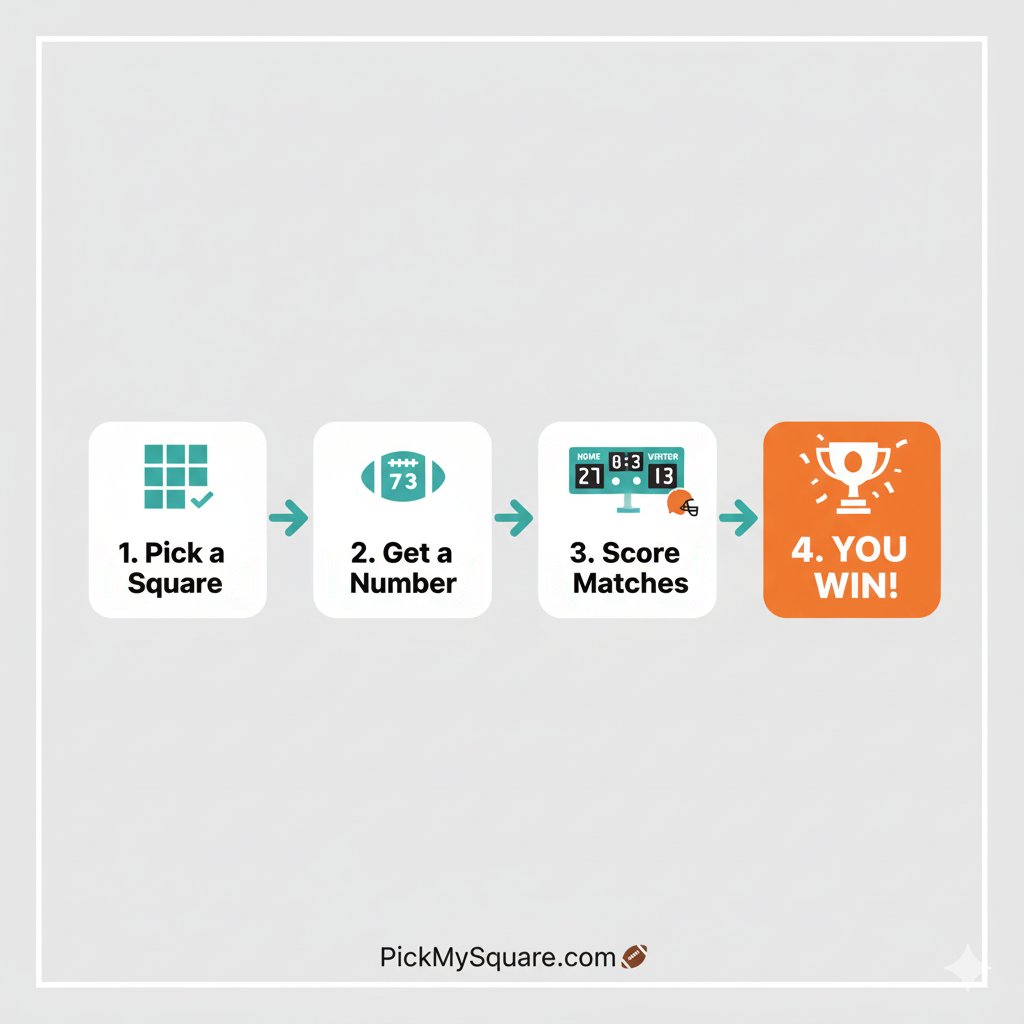
PickMySquare never handles entry fees or prizes. The board is a free tool that tracks who has which square, randomly assigns the numbers, and shows the live score as the game plays out. Whatever your group is playing for (cash, gift cards, bragging rights) gets arranged entirely off the site, between the people in your pool, the same way it would with a paper printout and an envelope of cash. We're not in the payment business, on purpose. Take a look at how the whole thing actually works before you set one up, or start from our dedicated Super Bowl squares page if that's the game you're planning around.
"Is football squares legal in my state" doesn't have one universal answer, and that's exactly why we didn't try to force one into a table above. One more time, since it matters: none of this is legal advice, and we're not attorneys. The general shape holds across most states, but "most" isn't "all," and laws change. If real money and any real scale are involved, check with your own state's gaming authority or a local attorney before you collect a dime.
Football Squares Legality FAQ
Are football squares legal?
It depends on how the pool is set up. A paid squares board checks the same three boxes state law uses to define gambling: an entry fee (consideration), a randomly assigned winner (chance), and a payout (prize). When all three line up, it counts as gambling under most state definitions, though actual enforcement against casual pools is rare. Take the entry fee out and it generally isn't gambling at all under that same test, since removing consideration is what most states' definitions turn on. Rules still vary by state, and this isn't legal advice, so treat that as the general shape rather than a guarantee.
Is it legal to run a squares pool at work?
In most states it isn't strictly legal if real money changes hands, but enforcement against casual office pools is rare, per the employment lawyers SHRM quoted back in 2017. The practical risk is more of a workplace policy issue than a legal one. Free-to-play removes the consideration element most gambling definitions turn on, which is the more reliable fix.
Is a Super Bowl squares pool legal?
The same rules apply to a Super Bowl squares pool as any other squares pool. It's just the highest-profile version of the format, with more money on the table and more attention on it, which is exactly why the question comes up most around it. A free-to-enter board removes the consideration element the same way any free pool does, and a small paid pool among coworkers or friends who already know each other usually falls under the same social-gambling shape that covers a regular-season board.
Does my state legalizing sports betting mean my squares pool is legal too?
No. Licensed sports betting and private social gambling are governed by different parts of the law. A state can allow one without touching the other.
Is running squares as a school or nonprofit fundraiser treated differently than a casual pool?
Yes. A paid fundraiser counts as charitable gaming, a separate and usually stricter category that often requires a state permit. Alabama, Hawaii, and Utah don't offer a workable exception for a paid nonprofit raffle at all, so a free-to-enter model with a donated prize is the safer route in those three states.
Does PickMySquare handle the money for a pool?
No, never. PickMySquare never handles entry fees or prizes. The board tracks squares and scores; all collection and payouts happen on your end, the same way they always have.
Run Your Squares Board the Free Way
Set up a free digital squares board in about a minute. PickMySquare tracks the grid, randomizes the numbers, and shows live scores, and it never touches a dollar of your pool's money.
Create Free Board →