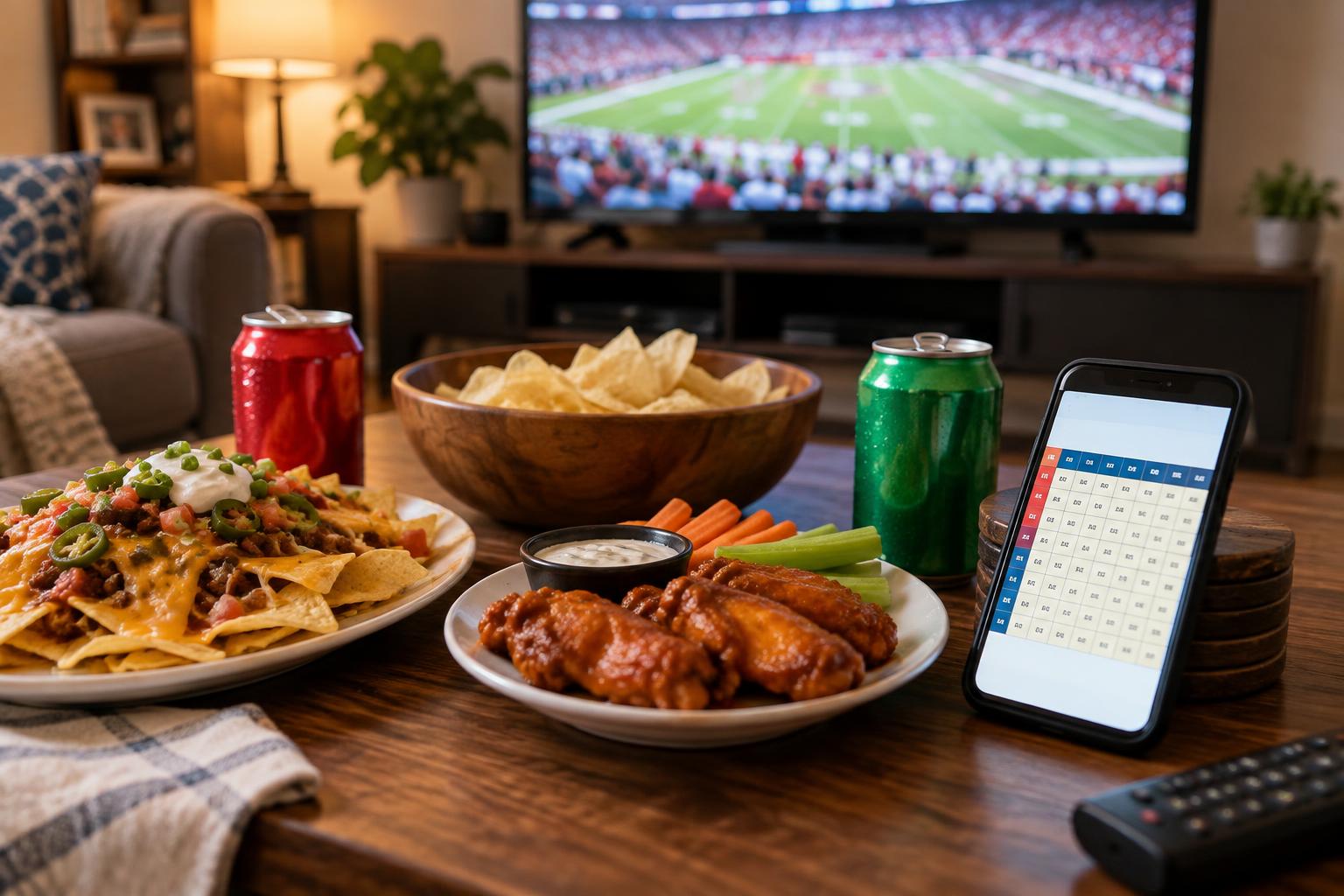
There is no sports day quite like a college football Saturday, and there's no better excuse to run college football squares. The NFL gives you a tidy handful of Sunday windows. College football hands you twelve straight hours of noise, with ranked teams kicking off at noon and something ridiculous happening in a stadium you've never heard of by midnight. This Saturday alone you've got No. 1 Texas rolling into Neyland to face Tennessee at noon on ABC, Illinois at Ohio State in the same window, and a full Week 5 slate stacked behind it. (Texas is ranked first for now. Ask me again after the Vols get done with them.)
That much football is perfect for squares. One board, one game, and suddenly every score change means something to somebody in your group chat. If you've never run a college board before, or you've only done the office Super Bowl grid, this is the easy on-ramp.
Why college football is made for squares
Squares works best when scores move in unpredictable ways, and nobody scores in weirder chunks than college teams. You get two-point conversions, missed extra points, safeties, defensive touchdowns, and offenses that will hang 49 points on a Tuesday. The last-digit pairing that decides each quarter's winner (say, Tennessee on 7, the opponent on 3) lands all over the board instead of clustering on the same tired numbers.
That's the whole appeal. In a squares pool, nobody needs to know a thing about the teams. Your cousin who thinks the SEC is a government agency has the exact same shot as the guy who watches every snap. You draw random numbers, you get your squares, and the game takes it from there. If you want the longer version of how the digits shake out, the beginner's guide to football squares breaks it down without the jargon.
Pick the right Saturday game
Here's where a little judgment pays off. You want a game your whole group will actually watch, not just the one with the highest ranking next to it.
A rivalry game or a marquee ranked matchup is the obvious pick. Texas at Tennessee is a great example: national TV, a noon kickoff so the board pays out before people wander off, and enough juice that everyone stays locked in for four quarters. A blowout can still be fun for squares because the score keeps ticking, but a close game keeps every quarter tense.
If your group is spread across a bunch of teams, pick the game with the most shared interest rather than the highest total. A shootout is more fun for squares than a 9-6 defensive slog, since more scoring means more chances for a new last-digit combo to hit. But you truly cannot predict this in advance, so don't overthink it. Any real game works.
One more practical note: college start times are all over the place. Noon, 3:30, the 7 or 7:30 primetime slot, and the occasional after-dark game on the West Coast. A noon kickoff is the friendliest for a group board because the quarters land at reasonable hours and nobody's chasing a final payout at 1 a.m.
Setting up a college football board
The mechanics are identical to any other squares board. You've got a 10x10 grid, 100 squares total. One team's last-digit runs across the top, the other's runs down the side. People claim squares, then the numbers get drawn at random after the grid fills.
The part people mess up is drawing the numbers too early. Don't assign 0 through 9 to the rows and columns until the board is full or close to it. If the numbers are visible while people are still claiming, everyone fights over the good digits (0, 7, 3, 4) and your board fills unevenly. Random assignment after the fact is what keeps it fair, and it's the single most important rule for a clean pool. Our guide to running football squares walks through the timing if you're organizing for the first time.
Payouts are up to you. The standard is one winner per quarter, with the fourth quarter (the final score) usually worth the most. A common split is something like 20 percent for the first three quarters and 40 percent for the final. You can also pay out on halftime instead of Q1 and Q3 if your crowd tends to drift. Whatever you decide, say it out loud before the board fills so there are no arguments in the third quarter.
Running it on PickMySquare
Doing this on paper works fine, right up until you're texting a photo of a smudged grid to fourteen people and someone claims a square that's already taken. That's the part we built to disappear.
You create a free board, pick the two teams and the kickoff, and share one link. People claim their own squares from their phones, the numbers draw randomly when you're ready, and the board updates the score as the game goes. When a quarter ends, the winning square lights up on its own. No spreadsheet, no math at halftime, no "wait, who had 7-4?"
And since squares boards work for any sport with a score, the same account you use for a Saturday college game covers your Sunday NFL board, a Thursday nighter, a bowl game in December, or a random Tuesday basketball game if that's your thing. You're not locked into one league.
A quick word on strategy
There isn't much, and that's a feature, not a bug. In a properly randomized board you have zero control over which numbers you get, so "strategy" is really just knowing which digits tend to win. Zero and 7 are the strongest because of how football scoring works. Field goals and touchdowns push toward 0, 3, 7, and 4 far more often than 2, 5, or 8. If you're picking a board with pre-assigned numbers (some pools do this), lean toward those. If the numbers are random, just enjoy the chaos. The squares strategy guide has the full breakdown of which combos actually hit.
Compared to fantasy, this is a rounding error of effort. No draft, no waiver wire, no setting a lineup at 11:58 on Saturday morning. If you've ever wanted your less-committed friends in on the fun without a season-long commitment, squares is the answer. We made that case in more detail here.
College Football Squares FAQ
Do I need to know the teams to play college football squares?
Not at all. The numbers are drawn at random, so a first-time viewer has the same odds as a diehard. That's what makes squares great for a mixed group.
How many people do I need for a board?
A full board is 100 squares, but you don't need 100 people. Plenty of groups have each person claim several squares. Ten friends grabbing ten squares each fills the grid fine.
When should I draw the numbers?
After the board is full, or close to it. Drawing numbers before people claim their squares lets everyone chase the good digits and ruins the fairness. Random assignment at the end is the whole point.
Which numbers are best in a college game?
Zero and 7 are historically the strongest, with 3 and 4 close behind, because of how field goals and touchdowns stack up. In a truly random board you can't pick them, so it's more trivia than strategy.
Can I run a board for a game that isn't on national TV?
Yes. Squares works for any game with a score. Pick whatever game your group actually wants to watch, ranked or not.
Does it cost anything to set up a board?
No. Creating and running a board on PickMySquare is free. We never touch any pool money, so whatever your group does about a snack pool or bragging rights stays entirely between you.
Ready for Saturday?
Set up your college football board in about a minute and send out one link. People grab their squares right from their phones, and the board marks each quarter's winner for you.
Create Free Board →