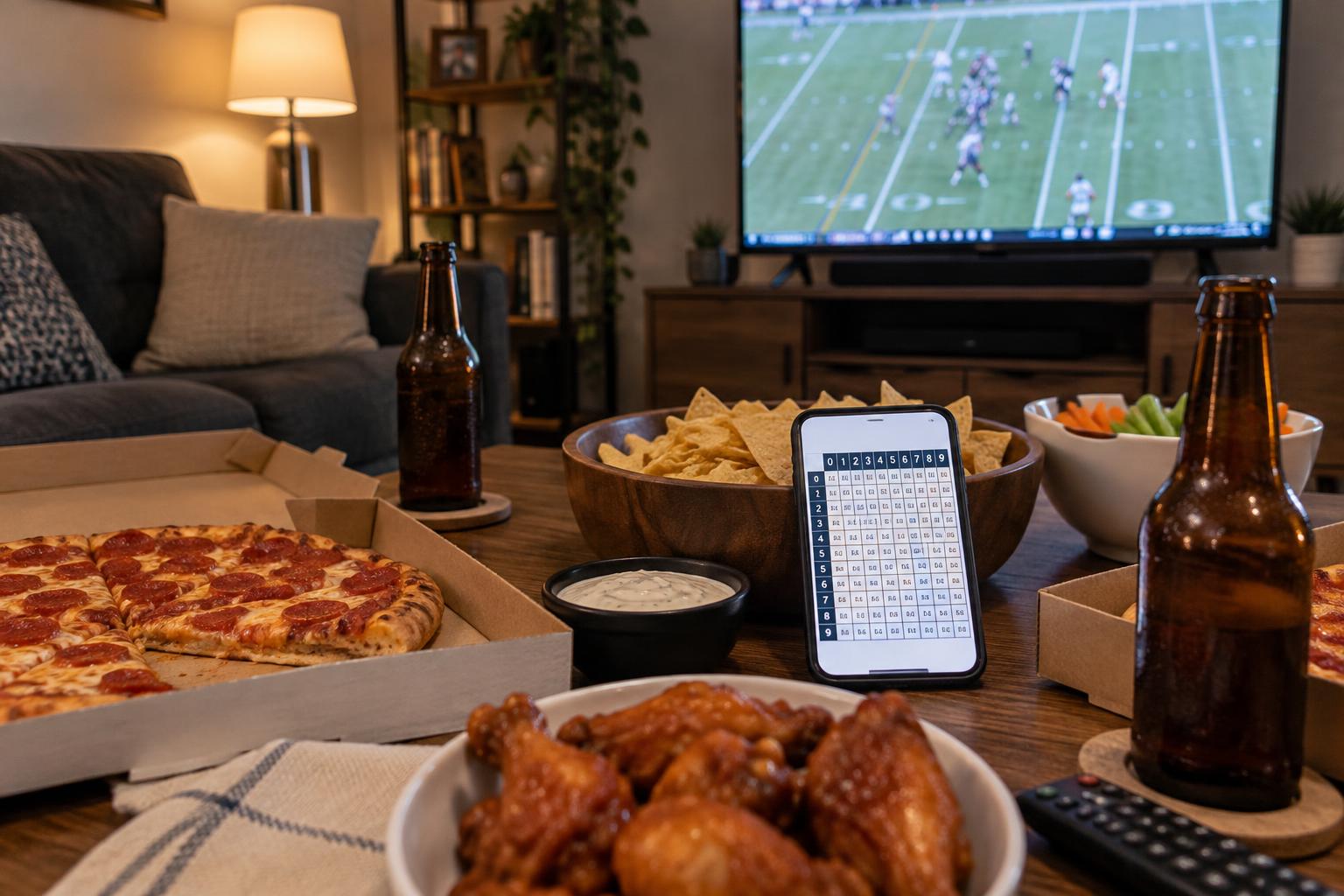
There's a specific kind of quiet that hits a room around 8:15 on a Sunday night. The afternoon slate is over, everybody's fantasy hopes have already been crushed or confirmed, and the only football left is the one game NBC decided the whole country should watch together. That's the window. That's when a Sunday Night Football squares board goes from "fun thing we did at the tailgate" to the reason nobody leaves the couch until the two-minute warning.
This week it's Rams at Broncos out at Mile High, the last of fourteen games on the Week 3 Sunday and the one everyone circles. Denver's crowd noise is a real thing, the Rams have looked sharp, and it's exactly the kind of matchup where a slow first quarter can flip into a shootout by the fourth. Which is to say: a great one to put numbers on.
Why the night game beats the afternoon board
I run afternoon boards too, and they're fine. But a 1 o'clock board is competing with six other games, a fantasy lineup, and somebody's kid's soccer thing. Attention is split. A Sunday night board has none of that. It's one game, primetime, national broadcast, and everybody who's in your board is watching the same play at the same time. When that first score lands and somebody hits, the group chat lights up instantly because there's nothing else going on.
The single-game focus also makes the squares themselves feel bigger. In a squares pool you're not picking who wins, you're on the last digit of each team's score at the end of every quarter. One board, four chances to win (end of Q1, Q2, Q3, and the final), and the digits get assigned randomly after every square is claimed. If you've never set one up, the beginner's guide to football squares walks through the whole thing in about five minutes. The short version: 10x10 grid, one axis is the Rams, the other is the Broncos, numbers drop after the grid fills.
Building it so it fills before kickoff
The number one way a primetime board dies is by not filling in time. You post it Thursday, three people grab squares, and by Sunday afternoon you've got 40 empty cells and a board that pays out to nobody in particular. A few things that actually move the needle:
Get it out early in the week and pin it. Sunday night games get announced way ahead, so there's no reason to wait. Monday or Tuesday, drop the link in whatever group you're using and say the numbers get assigned Sunday at 7. People respond to a deadline.
Let folks grab more than one square. A 100-square grid needs bodies. If you've got 15 people, that's six or seven squares each, and that's a good thing. More of the board covered, more reactions when a number hits. On PickMySquare you set the per-person limit yourself, so you can cap it or leave it open depending on your crowd.
Don't overthink the payouts. Even split across the four quarters is the honest default, but Sunday night games have a rhythm where the halftime and final scores carry the most weight, so a lot of hosts weight those two heavier. There's a longer breakdown of quarter weighting and other tweaks in the strategy guide if you want to get into it. For a casual night board, even splits keep it simple and nobody argues.
The numbers that actually matter under the lights
Here's the part people always want to know: which squares are good? In NFL scoring, the digits 0, 3, and 7 do a disproportionate amount of the winning. Field goals give you 3s, touchdowns with the extra point give you 7s, and 0-0 is where every game starts. So 0-0, 0-3, 3-7, 7-0, those combos hit way more than their fair share.
But, and this is the whole beauty of squares, you don't get to pick your numbers. They're assigned at random after the grid fills. So knowing the good digits doesn't help you claim them, it just tells you whether to feel smug or doomed once the draw happens. Somebody at your board is going to get 2-5 and spend the whole night rooting for a safety and a missed extra point. That's the game. If you want to actually understand the odds behind those hot squares, the Sunday NFL squares guide has the full digit breakdown.
Primetime games do lean a little higher-scoring than the afternoon average, especially when the offenses are healthy. The Rams and Broncos both throw it around, so I wouldn't be shocked to see 7s and 4s (the extra touchdown) do work by the fourth quarter.
Running it without becoming the accountant
The old way to run a Sunday night board was a printed grid taped to the fridge and you, the host, chasing people for their squares and doing the math at every quarter. That's the part that burns hosts out. A digital board fills itself, assigns the random numbers automatically, and marks the winner at the end of each quarter as the live score updates, so you get to actually watch the game instead of squinting at a spreadsheet during commercial breaks.
If you're hosting for a bigger group or doing this every week through the season, the how to run football squares post covers the host-side stuff: reminders, collecting nothing but attention (PickMySquare doesn't touch money, it's just the board), and keeping people coming back week to week. A standing Sunday night board that resets every week is one of the easiest ways to build a little tradition with your group.
FAQ
What is a Sunday Night Football squares board?
It's a 10x10 grid tied to the week's SNF game. Each column is a digit for one team, each row a digit for the other, and you win if your square matches the last digit of both teams' scores at the end of a quarter.
When do the numbers get assigned?
After every square is claimed. The random draw is the whole point, so you assign numbers once the grid is full, ideally right before the 7:00 pregame show so nobody's grabbing squares knowing what they're getting.
What are the best squares to have?
0, 3, and 7 win the most in NFL scoring because of field goals, touchdowns, and extra points. But you can't choose your numbers, they're assigned at random, so the "best" square is just luck of the draw.
How many people do I need?
You can run it with as few as five if everybody grabs multiple squares, but a full 100-square grid feels best with 10 to 20 people. Set your own per-person square limit to control it.
Does it cost anything to run a board?
No. PickMySquare boards are free and we never process pool money. Any entry fee or prize is handled between you and your group however you want.
Can I do this for every Sunday night game?
Yes, and a lot of hosts run a fresh board every week of the regular season. Each SNF matchup gets its own grid, new numbers, new winners.
Build Your Sunday Night Board
Set up a free squares board for this week's primetime game in about a minute. Share the link, let it fill, and let the numbers drop themselves.
Create Free Board →