The number one fight in any squares pool isn't who wins. It's whether the pool pays out at the end of every quarter or only when the clock hits triple zero. I've watched a perfectly good Sunday party get weird because half the room assumed one thing and half assumed the other, and nobody said it out loud before kickoff. So let's settle it.
Here's the short version of how football squares scoring works: most pools pay a winner at the end of each quarter and a bigger one at the final score. But "most" isn't "all," and the details of how you handle overtime, halftime, and a scoreless first quarter are exactly the details people forget to write down. That's where the arguments come from.
How quarter scoring actually works
Every square on the grid lines up with two digits, one from the column (say, the Chiefs) and one from the row (say, the Eagles). Those digits come from the last number in each team's score.
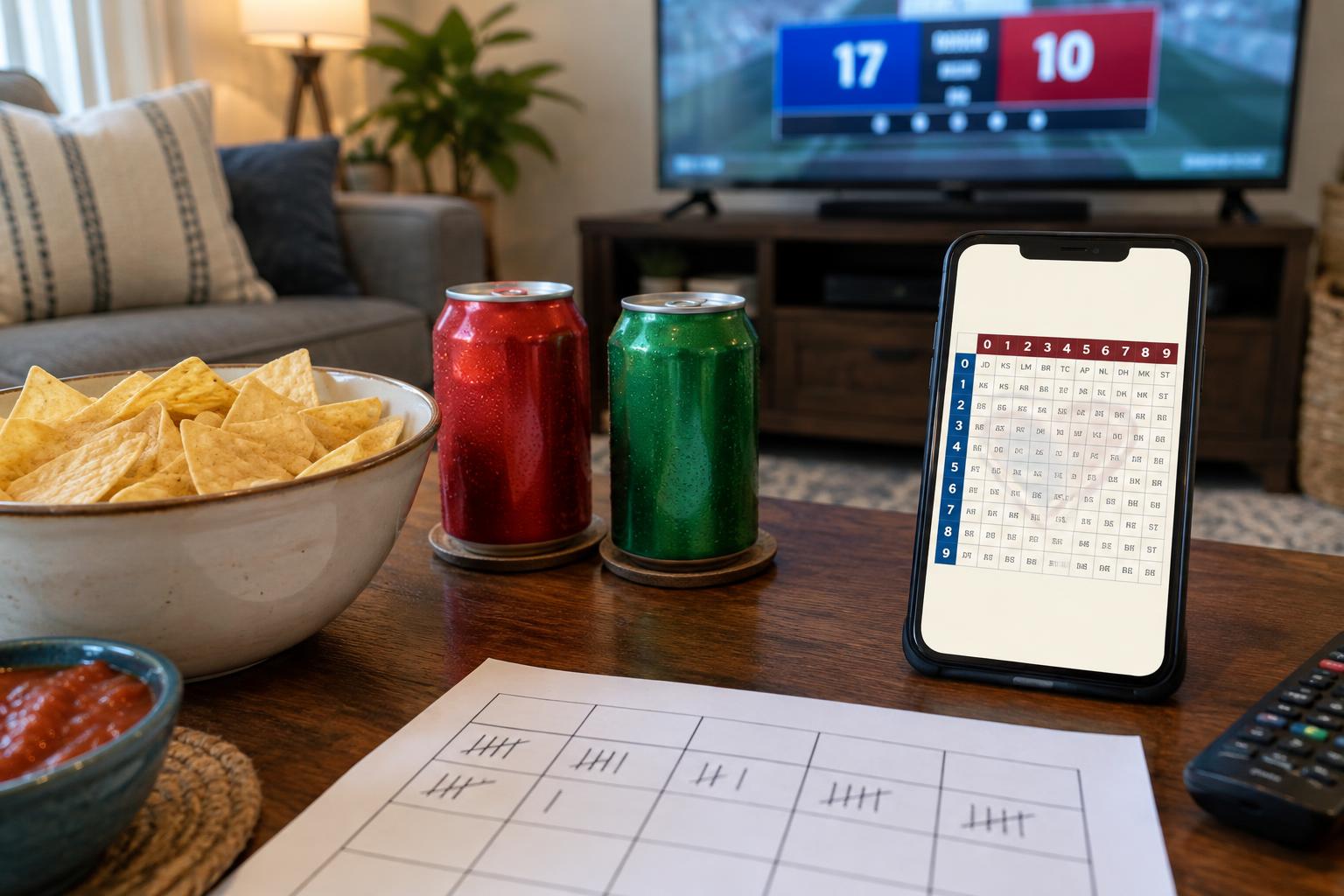
When a quarter ends, you take both scores and drop everything but the ones digit. Chiefs up 17, Eagles sitting on 10? That's a 7 and a 0. Find the square where the Chiefs' 7 meets the Eagles' 0, and whoever's name is in that box wins the quarter. You do that four times: end of the first, end of the second (which is the halftime score), end of the third, and at the final.
The reason you only use the last digit is simple. Scores climb into the teens, twenties, thirties, but a squares grid is only ten by ten. A 24 and a 24 both land on the 4. That's why a boring 3-0 first quarter still pays somebody, and it's part of what makes the game fun for people who don't care about football at all. If you're brand new to any of this, the beginner's guide to football squares walks through the setup from an empty grid.
Quarter lines vs the final score, and why the final is worth more
Four scoring moments, four winners. That's the standard. What trips people up is that those four payouts usually aren't equal.
The most common split I see is 25% at each of the first three quarters and 25% at the final. Clean, easy math, nobody feels cheated. But plenty of organizers weight the ending heavier because the final score is the one everybody's watching. A 20/20/20/40 split hands the last winner the biggest slice, which keeps the pool interesting deep into the fourth quarter even for someone whose square went cold in the second.
I'll go a step further and say the weighted split is the better call for most groups. If your first three payouts are identical and the final is only worth the same as the first quarter, half your grid stops caring by the third possession. Give the ending some weight and people stay glued to a game that's already decided on the scoreboard. That's the whole point of squares: a reason to watch a blowout.
Whatever you pick, write the percentages down before anyone joins the board. Escalating splits, where each quarter is worth a little more than the last, work great too. The split itself matters way less than the fact that everyone saw it before the coin toss.
The two rules people forget: overtime and the halftime score
Two situations cause more squares drama than everything else combined.
The second-quarter payout is the halftime score. There's no separate "halftime" winner. The score at the end of the second quarter is your second payout, full stop. New organizers sometimes think halftime is a fifth prize. It isn't.
Overtime is where you need a written rule. When a game goes to OT, does the final-score payout use the score at the end of regulation, or the actual final after overtime? Both are legitimate. Most pools use the true final, including OT points, because that's the "real" ending. But if you said nothing, you've got two people who can each make a fair case, and now you're refereeing. Decide it up front. My preference is to pay on the official final including overtime, since that's the number the league records and the one nobody can argue with later.
While you're at it, decide what happens if a quarter ends 0-0. Somebody owns the 0-0 square, and they win, even though nothing happened. That's not a glitch. That's the game.
Does this change for college or the pros?
The scoring math is identical whether you're running an NFL Sunday board, a Saturday college game, or the national championship. Four quarters, last digit of each score, done. College football tends to put up higher totals thanks to faster offenses, but since you only ever use the ones digit, a 45-38 shootout scores the exact same way as a 10-7 slog.
The one thing worth knowing: squares work for any sport that keeps a running score. Basketball, hockey, whatever has a scoreboard. So if you love the quarter-by-quarter rhythm of squares but it's April, you're not stuck. That's a totally different animal from a March Madness bracket pool, which is about picking the tournament, not matching score digits. Two separate games, two separate reasons to gather people.
Setting your payouts without doing math on game day
The cleanest pools decide three things before anyone claims a square:
The percentage each quarter pays. Whether the final includes overtime. And whether the numbers are drawn randomly after the grid fills (they should be, and any decent tool handles this for you).
If you want to get sharper about which of those number combos actually come up more often, the squares strategy guide breaks down why 0s and 7s carry their reputation and why the corners of the grid are quietly the best real estate. It won't help you pick a winning square (the draw is random on purpose), but it'll help you set expectations for a room full of people who think they can outsmart a coin flip.
Football squares scoring FAQ
Do all four quarters pay out, or just the final score?
That's your call as the organizer, but the standard is all four: end of Q1, Q2 (halftime), Q3, and the final. Paying every quarter keeps more people invested, which is the whole reason to run a board.
How do you calculate the winning square each quarter?
Take the last digit of each team's score at the end of the quarter. Match those two digits to the row and column on the grid. Whoever owns that square wins.
What happens to the second-quarter payout, is that halftime?
Yes. The end-of-second-quarter score is the halftime score, and it's your second payout. There's no separate halftime prize on top of it.
Does overtime count toward the final-score payout?
Only if your rules say so, which is exactly why you write it down. Most pools use the true final including overtime. Decide before kickoff so nobody argues at midnight.
Should each quarter pay the same amount?
Equal 25/25/25/25 works, but weighting the final heavier (like 20/20/20/40) keeps people locked in even when the game's out of reach. I'd go weighted for most groups.
Can I use quarter scoring for basketball or other sports?
Squares scoring works for any sport with a running score. The NBA plays quarters, so it maps over cleanly; for a two-half game like men's college basketball you'd score by halves and the final instead. Bracket pools work for any single-elimination tournament, though March Madness is the most popular one.
Set your payouts, we'll handle the scoring
Build a board in about a minute. Pick your quarter splits, invite your crew, and let the grid track every winner from the first quarter to the final. No math, no arguments.
Create Free Board →